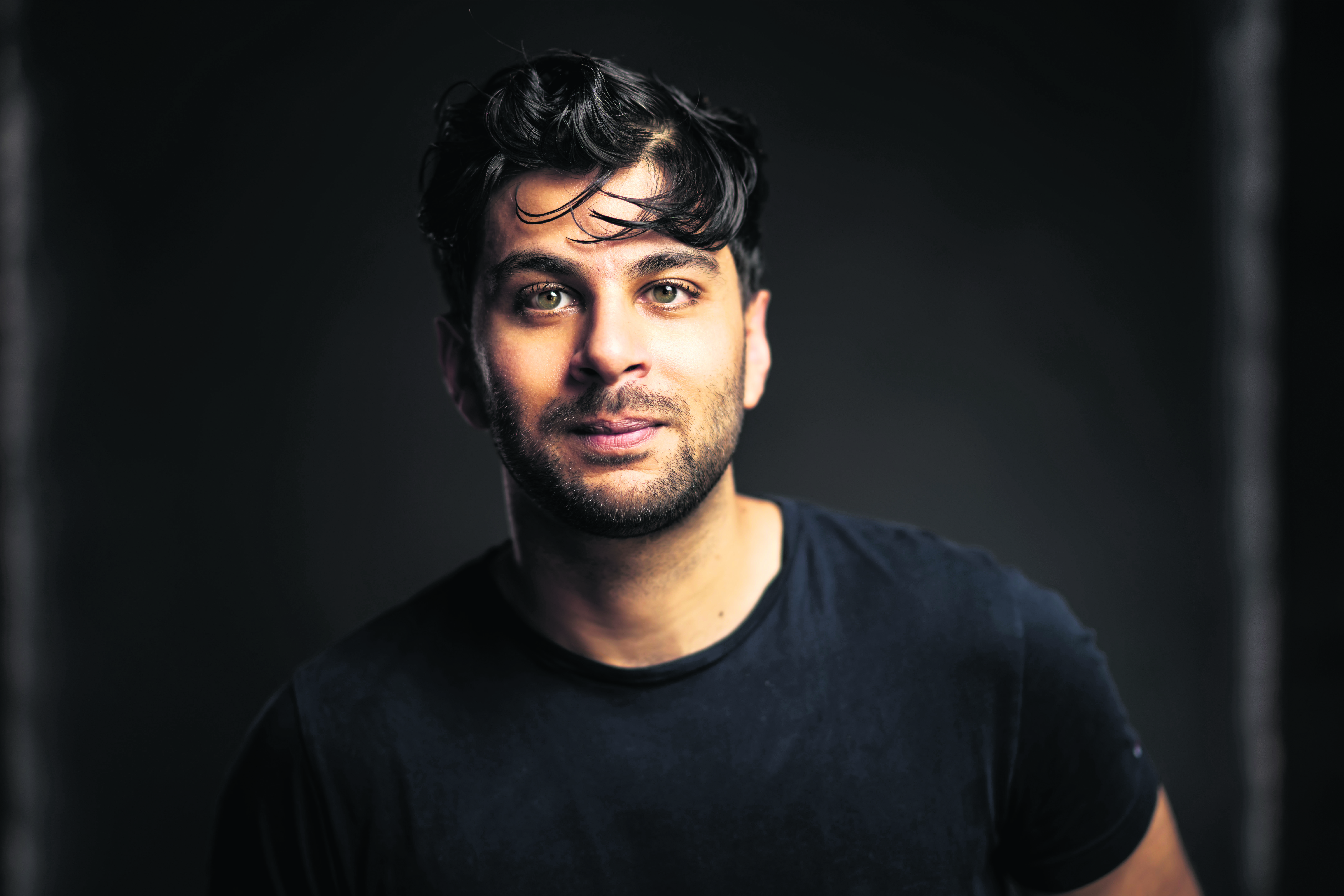

The Royal Court Theatre has officially unveiled its cast for Mohamed-Zain Dada's debut play, "Blue Mist," directed by Royal Court Associate Director Milli Bhatia. The cast includes Salman Akhtar, Omar Bynon, and Arian Nik.
"Blue Mist" unfolds within the shisha lounges of North West London, weaving a narrative that traces the journey of a journalist who compromises his own community. This compelling storyline serves as a candid response to the portrayal of South Asian Muslim men in the media.
Speaking to Asian Voice, Mohamed-Zain Dada discusses his play, writing process and his inspiration.
Can you provide a brief overview of the storyline and key characters in your play?
Blue Mist follows Jihad, an aspiring journalist who reconnects with his two childhood friends, Rashid and Asif. At Chunkyz shisha lounge, jokes flow, laughter follows and ideas are born. It's a home away from home for them. When Jihad's idea for a documentary about Chunkyz and shisha lounges across the country wins a competition with a big production company, his boys are overjoyed. It could be his big break.
But when the production company, Ajami Media starts making demands on the narrative of the proposed documentary, Jihad has to make painstaking choices about the kind of journalist he wants to be. The decisions he makes threatens to split his beliefs in two.
Can you tell us about the inspiration behind your play and what motivated you to address the portrayal of South Asian Muslim men in the media?
I hadn't originally set out to write a play with the intention of addressing South Asian Muslim men in the media. It was initially about capturing the joy and fun of spaces like Chunkyz shisha lounge where you can be the fullest version of yourself. After reading legendary writer Parv Bancil's play, 'Made in England,' I was interested in exploring the tension between integrity and ambition and this really became the heart of the play.
How do you approach character development in your play to create authentic and multi-dimensional South Asian characters?
Poet and playwright, Suhaiymah Manzoor-Khan's 'This is not a humanizing poem' comes to mind. The poem is about breaking the binary between the 'good Muslim' and 'bad Muslim' and affording communities the ability to be flawed and broken. I try my best to take the same approach with writing.
What research or personal experiences guided your portrayal of the South Asian diaspora, and how do you envision your play impacting perceptions?
Lots of research went into the play, both informal and formal. I remember the first shisha lounge I ever went to being in Trocadero in Leicester Square (when you could smoke indoors). After that, Edgware Road became the place to be and now in London at least, Park Royal. Whilst I wrote the play, I also co-wrote a 'zine' (small magazine) commissioned by the Arab arts festival, Shubbak which explores the stories of shisha lounge owners in North West London. I heard so many incredible stories and many of them inspired some of the scenes in the play.
But a huge part of this play is touching points of growing up young, Muslim and South Asian in Britain from the dramas at Friday prayers, fillet-o-fish to the absurdities of gym culture. It's really about being able to laugh at the silliness and jokes that come from our communities.
How can the portrayal of the South Asian diaspora in mainstream media be improved, and how do you see the role of theatre and storytelling in fostering empathy among diverse audiences?
I think it's helpful to look back at history. In 1978, sociologist Stuart Hall wrote a book called 'Policing the Crisis' which was a commentary on race relations in Britain in the 1970s. The book explores how the idea of a 'Black mugger' perpetuated by the media and politicians in the UK created an entirely fictionalised crisis. That era consisted of sensationalist news reports about an increase in mugging by 'unemployed Black youth.' We can see parallels between this and comments made by Home Secretary, Suella Braverman about grooming gangs and British-Pakistani men. My point is that the same tactics are often used in order to distract and manufacture outrage and it'll often shift from community to community which is why solidarity is so important.
What advice do you have for aspiring writers who want to create more inclusive and accurate portrayals of underrepresented communities in their work?
I think it's important to acknowledge how tough it is for aspiring writers right now which is why it's important to connect with your peers. One of the best pieces of advice I've got was from writer Fatihma Asghar when I interviewed her for Khidr Collective (a zine platforming the voices of Muslim artists). Fatimah told me that "circles rise together" and that a scarcity mindset benefits no one.
Another piece of advice would be to find the right collaborators. I started writing Blue Mist on the Introduction to Playwriting group at the Royal Court and it's been a transformative experience for me. It's where I developed a working relationship with the brilliant director of this play, Milli Bhatia who really encouraged me to lean into the abstract and whose overall sense of purpose and drive in theatre has been massively inspiring for me. In a similar way, the literary team (Jane Fallowfield, Gurnesha Bola and Ellie Fulcher) have informed so many iterations of Blue Mist with delicate and thoughtful notes. The assumption with writing is often that it's a solitary act but I would advise writers to look for the right people who can provide constructive feedback that helps to nourish and grow your idea or improves your craft over time.